

Indonesia, with more than 17,000 islands and home to 10% of the world’s flora and fauna species, boasts extraordinary biodiversity. However, the country also faces significant environmental threats. According to Global Forest Watch, Indonesia lost approximately 9.75 million hectares of primary forest between 2001 and 2021, ranking among the highest deforestation rates worldwide. Additionally, a report by FAO reveals that 33% of coral reefs in Indonesia are critically damaged due to human activities.
These challenges not only impact ecosystems but also the communities that directly depend on natural resources. Data from Indonesian Central Bureau of Statistics (2023) shows that over 70% of coastal and forest communities rely on natural resources for their livelihoods. Ironically, these groups are often the most vulnerable to climate change and environmental exploitation, with poverty rates in coastal and forest regions reaching nearly 20%.
Globally, the IPCC (2023) highlights that resource-based communities, such as indigenous peoples and coastal communities, play a crucial role in ecosystem preservation. However, they often face limited access to resources, lack of legal recognition for customary lands, and minimal support for community-based management.

Recognizing the critical role of communities in conservation, seven environmental organizations across Indonesia joined forces in 2023 to form Our Earth Alliance. This alliance serves as a collective movement aiming to strengthen cross-organizational collaboration, create sustainable solutions, and empower communities as the main actors in environmental preservation.
Connecting Diverse Landscapes and Programs
Our Earth Alliance reflects Indonesia’s ecological complexity through the diverse landscapes and approaches of its member organizations. This uniqueness forms the foundation for providing relevant and adaptive solutions tailored to each region:

Tropical Forests of West Kalimantan: Planet Indonesia (YPI) empowers communities through community-based forest management, supporting nature-based economies, and biodiversity protection. This approach positions communities as primary ecosystem stewards.
Coastal and Forest Areas of Gorontalo: Perkumpulan Jaring Advokasi Pengelolaan SDA (Japesda) addresses cross-ecosystem issues, including marine, coastal, and terrestrial areas, integrating community-based management.

Hills of Flores: Yayasan Tananua Flores (YTNF) supports smallholder farmers by promoting sustainable land conservation practices. Their focus includes improving food security, restoring degraded land, and mitigating climate change, making local communities the driving force of change.
 Parrot Conservation: Konservasi Kakatua Indonesia (KKI) leads efforts to conserve parrot species by engaging indigenous communities in habitat preservation. This community-based approach protects species while safeguarding local cultural heritage.

Marine Ecosystems of Southeast Sulawesi: Toli-Toli Labengki Giant Clam Conservation (TLGC) works to conserve marine biodiversity, mainly endangered giant clams. Using community-based conservation, TLGC ensures the sustainability of marine ecosystems that support coastal livelihoods.
Forests and Coasts of Bengkulu: AKAR Global Initiative (AKAR) focuses on community-based management in forest and hilly areas prone to deforestation. AKAR integrates local empowerment to enhance agrarian sovereignty, restore forests, and involve indigenous communities in conservation.
Coastal and Marine Areas of Lombok: Juang Laut Lestari Foundation (JARI) leads initiatives to preserve coastal and marine ecosystems in West Nusa Tenggara. Through community-based management, JARI empowers local fishers, strengthens the role of women in marine resource management, and advocates for policies that support coastal ecosystem sustainability.
This diversity is the main strength of the BUMI KITA Alliance, allowing each member institution to provide solutions tailored to local challenges. More than just collaboration, the alliance aspires to realize a collective impact that connects different regions and ecosystems in one shared dream: a more sustainable future for people and the environment.
2023–2024: Building the Foundation and Strengthening Identity
In its early journey, Our Earth Alliance utilized 2023 and 2024 to establish a strong foundation as a cross-organizational collective movement. This period was marked by collaborative efforts to draft shared agreements, strengthen alliance identity, and develop collective capacity through online learning exchanges.
1. Drafting the Alliance Charter
This foundational document outlines the alliance's core model, values, and principles of collective work. The drafting process involved all member organizations, ensuring the document represented their collective aspirations.
2. Developing Identity
The alliance designed a logo, website, and branding elements to strengthen its presence nationally and internationally. The website serves as an information hub about programs, achievements, and the alliance’s vision.
This website will serve as a hub for reaching partners, donors, and the public.
3. Online Learning Exchanges
One of the core activities during 2024 is online learning exchange through cross-institutional knowledge sharing sessions. Two main topics discussed include:
- Local regulations for community-based water resource management.
This session explores local policies that support community-based resource management, including advocacy strategies that have been successfully implemented in member organizations’ areas of service. - Index for Community-Led Governance Body Analysis
Alliance members are studying the use of community-based indices to analyze the sustainability of marine and terrestrial ecosystems. These indices are becoming important tools for measuring the impact of conservation programs in a participatory and results-oriented way.
Moving Forward: Aiming for Greater Impact

From October 29–31, 2024, Our Earth Alliance held its second annual meeting in Lombok. This gathering reflected on past achievements and set new directions. Members discussed their shared vision, aligned priorities, and established long-term strategic plans.
Momen Refleksi: Belajar dari Perjalanan
The meeting began with reflections on the progress made over the past year. A key highlight was the success of inter-organizational learning exchanges, which strengthened networks and shared best practices across grassroots projects. However, members also recognized the need for more focused and measurable support—particularly in funding and coordination—to enable the alliance to thrive as a truly impactful collective movement.
This realization became the foundation for a deeper strategy built around three core objectives:
- Strengthening Collective Action
Our Earth Alliance reaffirmed its commitment to creating a shared learning platform. This platform will go beyond knowledge-sharing, becoming a collaborative space for designing programs that address the specific needs of each member organization while reflecting the alliance's shared vision. - Consolidating Funding
Acknowledging the critical role of financial sustainability, the alliance is developing a strategy to access national and international funding collaboratively. This approach is designed to not only support the alliance's collective goals but also enhance the financial resilience of individual member organizations. - Scaling Evidence-Based Impact
The alliance agreed to enhance its Monitoring, Evaluation, and Learning (MEL) systems to ensure programs are measurable and outcomes are effectively communicated. By showcasing impactful case studies, the alliance aims to inspire confidence among donors and stakeholders while strengthening its evidence base for community-driven initiatives.
A Democratic Structure for Leadership
To ensure clear and inclusive leadership, the alliance elected a new governance team for 2024–2027. This structure is designed to provide direction and transparency, supporting the collective impact vision while empowering all member organizations.
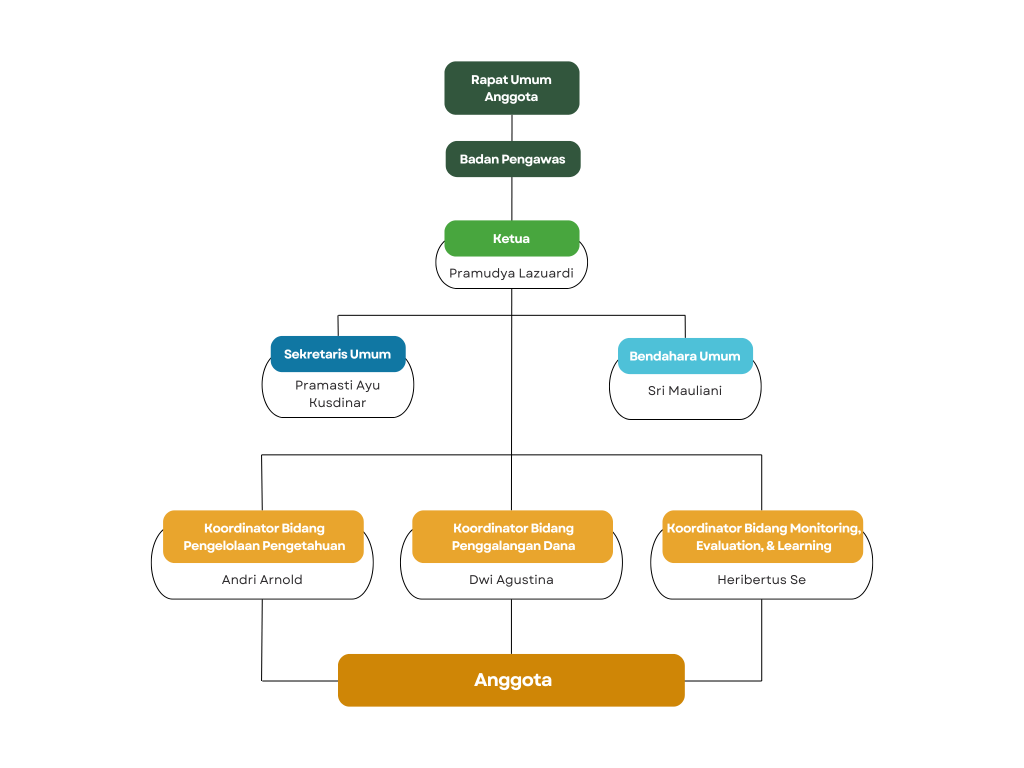
Scaling Impact Through Collaboration
Another major outcome of the meeting was a commitment to strengthen the capacity of each member organization. This includes scaling grassroots impacts through training, talent development, and better access to funding.
“This is not just about working together; it’s about creating a collaborative ecosystem where everyone grows and our impact multiplies,” said Pramudya Lazuardi, Chair of Our Earth Alliance.
Looking Ahead: Building a Strategic Foundation
The year 2025 marks a pivotal chapter for Our Earth Alliance, focusing on internal strengthening and strategic collaboration. This phase addresses past challenges while setting the stage for larger, more sustainable impacts.
1. Developing Organizational and Alliance-Wide Mapping Systems
To meet local and global demands, the alliance will create tools to map the strengths, challenges, and achievements of both member organizations and the alliance as a whole:
- Capacity and Impact Mapping: Identifying key strengths of each organization to enable more strategic collective planning.
- Organizational Profiling: Building profiles that highlight the achievements and roles of each member for donors and partners.
2. Fostering Alliance Identity and Internal Alignment
Ensuring all member organizations share a unified understanding of the alliance’s mission, vision, and goals will be a key focus.
- Alliance Guide: Developing a comprehensive document outlining values, principles, and collaboration mechanisms to strengthen collective identity.
- Streamlining Communication: Establishing efficient methods and platforms to enhance engagement and information-sharing across members.
3. Enhancing Peer-to-Peer Learning
Peer learning is a cornerstone of the alliance’s approach. In 2025, this will deepen through:
- Matching Needs and Expertise: Mapping the specific needs of each member institution and matching them with the expertise available in the alliance.
- Structured Peer Exchange Programs: Facilitating cross-learning through field visits and technical training tailored to regional challenges.
4. Streamlining Financial Management and Reporting
The BUMI KITA Alliance recognizes the importance of good financial governance to maintain credibility in the eyes of partners and donors. Therefore, the 2025 focus includes:
- Collaborative Financial System: Creating a transparent mechanism to manage shared alliance funding.
- Integrated Reporting: Developing standardized reports that showcase collective contributions and impacts.
5. Strengthening Monitoring, Evaluation, and Learning (MEL)
The alliance will invest in robust MEL frameworks to ensure its programs deliver measurable and scalable results:
- Alliance MEL System: Designing a framework to track collective program outcomes.
- Organizational MEL Capacity: Training members to independently evaluate and improve their initiatives.
Together for a Sustainable Future
Our Earth Alliance exemplifies the power of collaboration, connecting diverse ecosystems, communities, and visions. Since its inception in 2023, the alliance has demonstrated that collective action can create a strong foundation for long-term impact. By leveraging the unique strengths of each member organization, the alliance unites varied approaches into a cohesive, inclusive movement.
Looking forward, the challenges ahead require deeper support systems, stronger internal capacities, and integrated strategies to address local needs while positioning the alliance as a leader on the national and international stage.
We believe that big change starts with small, structured, and purposeful collaborations. That’s why we invite you—donors, partners, communities, and caring individuals—to join us on this journey. Together, we can protect fragile ecosystems, strengthen resource-dependent communities, and build a more sustainable future for Indonesia and the world.
Let’s collaborate for greater impact!
 EN
EN  ID
ID